
Sun Bridges 2AXDual-axis solar tracker with bifacial modules, 14.5 kWp
Sixteen bifacial modules on a single pole, in two wings: the plane turns around the pole and tilts to keep facing the sun, and the modules also catch light from the back. Every tracker has its own control cabinet and inverter, works on its own and is connected to the SunBridges platform.
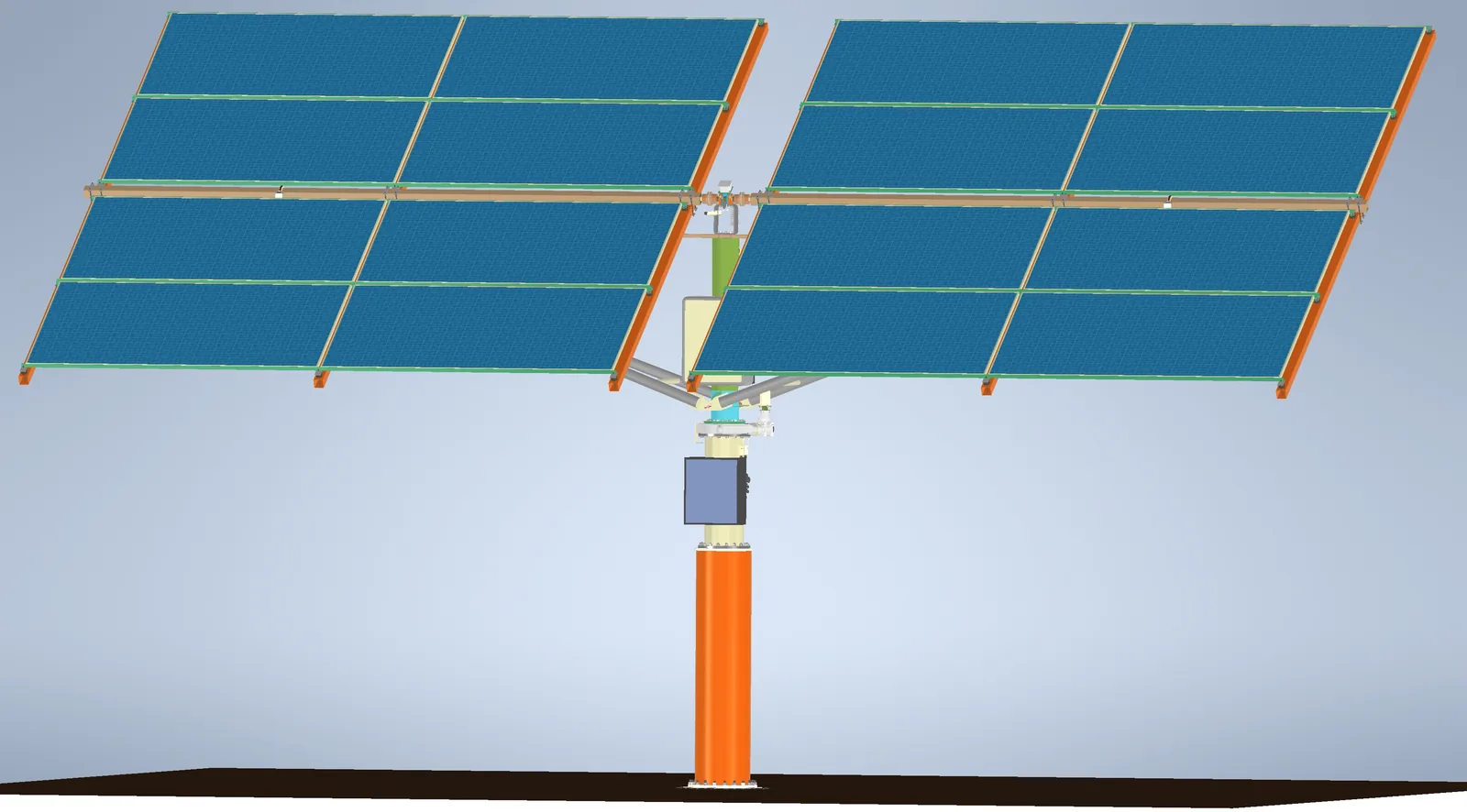
Two axes working together
A single-axis tracker only follows the sun from east to west. The Sun Bridges 2AX also follows its height, so the panels stay facing the sun all day long, in every season.
Azimuth
The plane turns on the pole from east to west, through 300 degrees, following the sun from morning to evening.
Elevation
The plane tilts to follow the height of the sun: more upright in the morning and evening, almost flat at noon in summer.
Up to 44% more energy
With the same modules, a dual-axis tracker collects more light than a fixed system, especially in the morning and evening. At Tecnopolo d’Abruzzo, according to PVGIS, the European Commission’s tool, the 14.5 kWp of a dual-axis tracker produce about 28,500 kWh a year; fixed at the best tilt, about 21,300: a third more. With bifacial modules, which on a tracker also catch light from the back, we estimate up to 44% more than a fixed south-facing panel.
+44%
Specifications
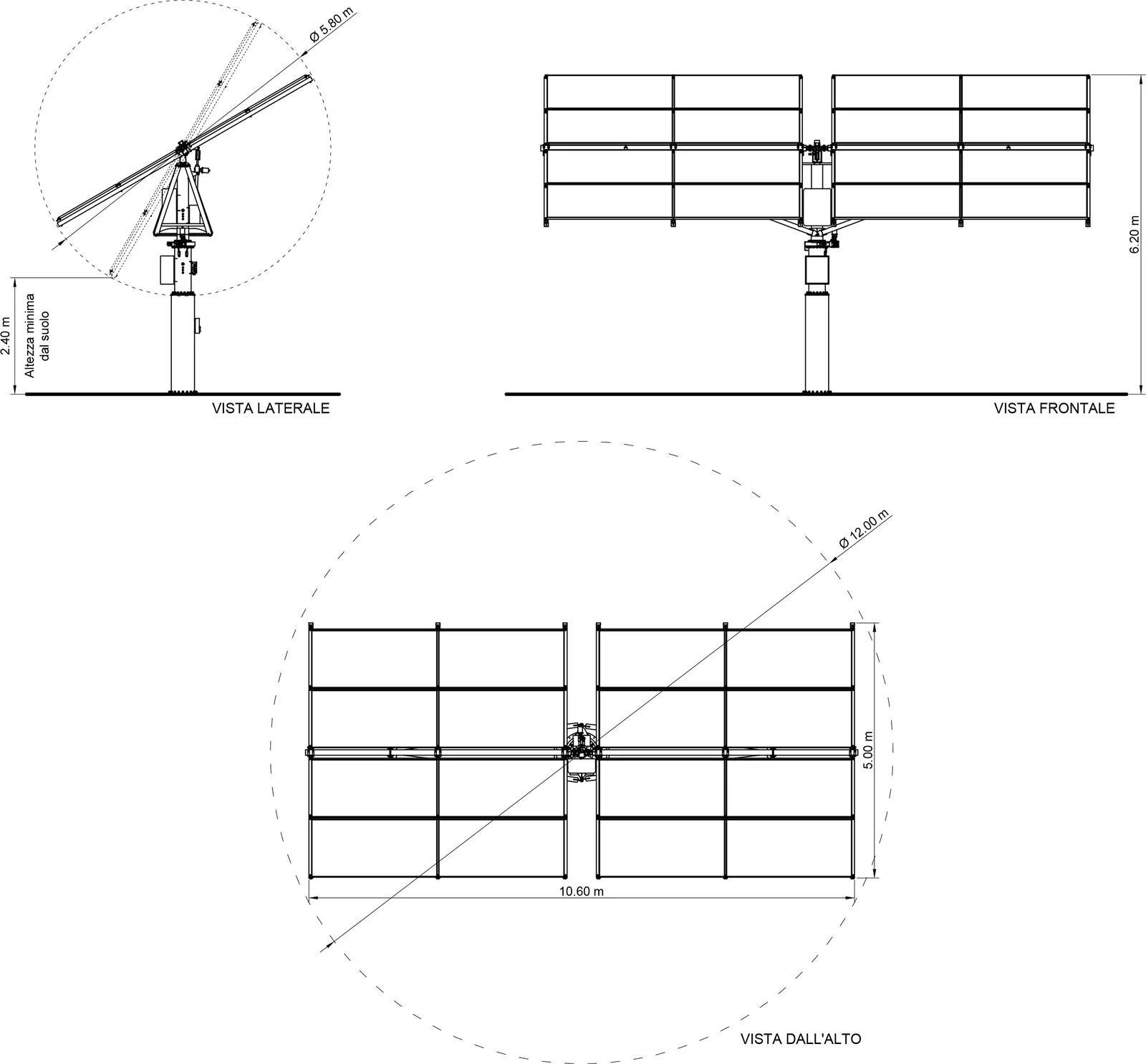
Standard Sun Bridges 2AX 16P configuration. Elevation is the angle between the plane and the vertical: at 90° the plane is horizontal. Ground clearance, charging and storage are chosen with the project.
- Rated power
- 14.5 kWp
- Modules
- 16 bifacial modules of 3.2 m², 51.2 m² in total
- Axes
- two, azimuth and elevation, with continuous movement
- Wind
- stays operational up to 120 km/h
- Azimuth rotation
- 300°, from -150° to +150° relative to south
- Plane elevation
- from 30° to 90°
- Plane size
- 10.60 x 5.70 m
- Maximum height
- 6.20 m
- Minimum ground clearance
- 2.40 m, from 0.40 to 10.00 m depending on the project
- Footprint
- a circle 12.00 m in diameter
- Spacing between trackers
- at least 14 m, so the land can be worked with machinery of any size
- Weight
- 1,725 kg, of which structure 1,085 kg and modules 640 kg
- Structure
- single pole with tubular space frame
- Drive
- two stepper motors with gearboxes, on a slewing ring, with limit switches on each axis
- Drive consumption
- 100 W
- Inverter
- on board every tracker, connected to the plant in alternating current with no further wiring
- Control cabinet
- outdoor, IP66, double insulated
- Electrical panels
- IP65, IEC certified
- Safety
- emergency stop button on the cabinet
- Cabinet power supply
- 230 V, with backup battery
- Connection
- Ethernet or 4G
- Monitoring
- SunBridges platform and Sun Bridges app
- EV charging, on request
- up to 22 kW three-phase, 400 V, 6 to 32 A, 6 m cable with Type 2 plug, MID meter
- Storage, on request
- from 4 to 128 kWh
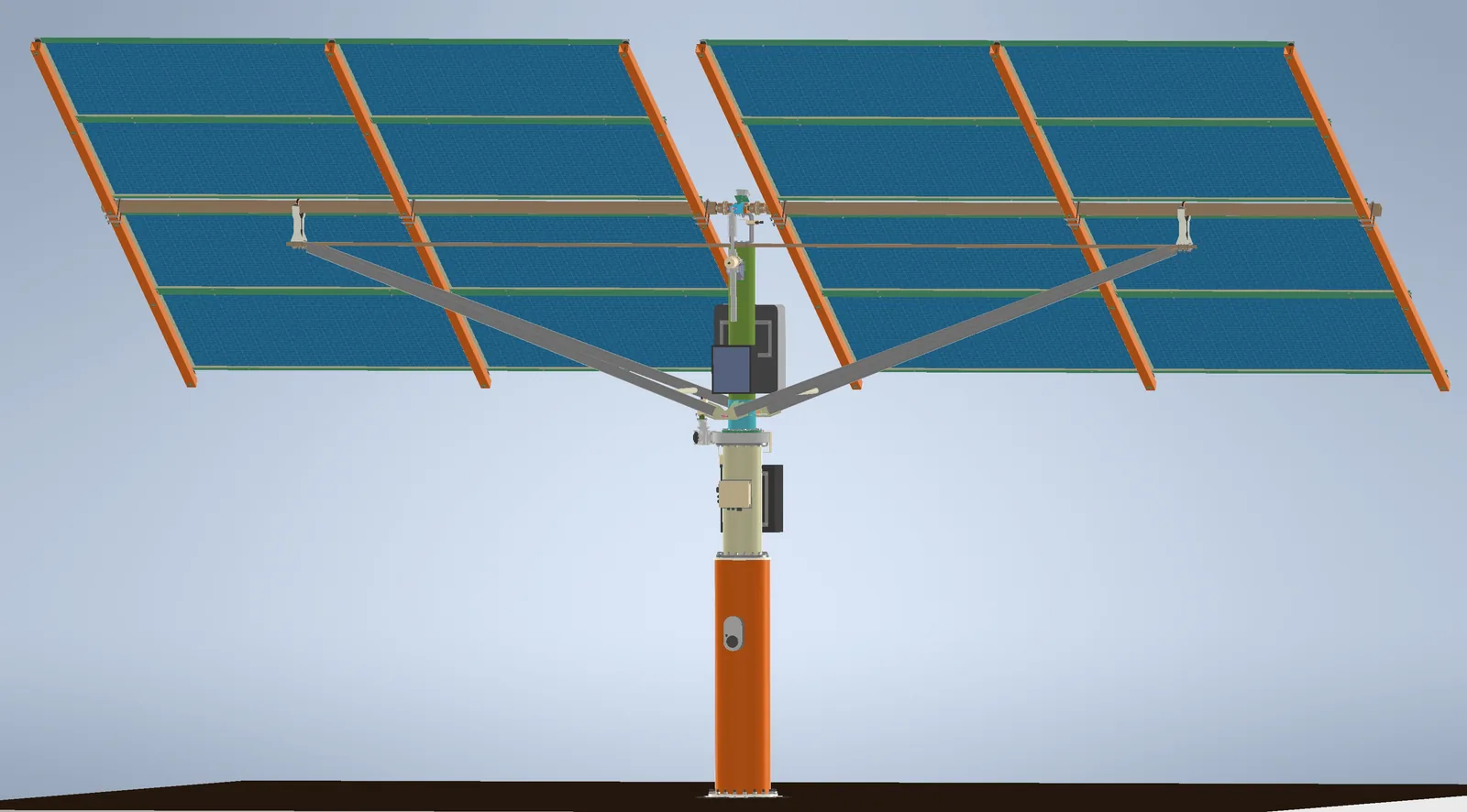
One control cabinet per tracker
Every tracker has its own control cabinet, mounted on the pole: a double-insulated outdoor enclosure with the control board, the motor drivers, the power supply with its backup battery and the emergency stop on the front. It connects to the network with an Ethernet cable, or with a 4G router inside the cabinet where no cable can reach.
Safety
- Emergency stop on the front of the cabinet: it stops the tracker on the spot.
- Remote stop: from the platform you can stop one tracker or the whole plant, and the button stays available even when other commands are locked.
- Maintenance lock: whoever works on a tracker locks its remote commands until they are done.
- Limit switches on each axis: if a movement reaches them, the cabinet stops and raises an alarm.
From one tracker to a whole field
A plant can have a single tracker or a field of two hundred. Each tracker has its own cabinet and the platform brings them together. In a field, several trackers share the inverter and the electrical panel, in an outdoor box with any batteries, so each kW costs less. The layout is planned on the site, with the right spacing so that trackers do not shade each other.
Ask for an assessment