
Your energy, following the sun
We design and build in L’Aquila, Italy, at Tecnopolo d’Abruzzo, a dual-axis solar tracker with a tree structure. From sunrise to sunset the bifacial module plane stays constantly perpendicular to the solar radiation for the highest efficiency in electricity production, all without taking up land.
- Time in L’Aquila
- 05:40Sunrise 06:53, sunset 16:49In Home until sunrise
- Turns on the pole
- 45°Azimuth
- Tilts
- 30°Elevation
- More energy in a year
- +44%than a fixed south-facing panel, with bifacial modulesHow it is calculated
The drawing is calculated right now, for L’Aquila: the dome is the sky, the yellow arc is today’s path of the sun. Below, the same tracker seen from above and from the side. The extra energy in a year, with bifacial modules, is the PVGIS figure plus the rear-side production declared by the module maker: real production depends on the weather and on the plant.
How it works, every day
The tracker does not wait for instructions: it knows where the sun will be and moves on its own. The network is there to watch and command it, not to keep it running.
It knows where the sun will be
The position of the sun is calculated in advance for the installation site, for every day of the year.
It follows it continuously
The drive and control system turns the panels in azimuth and tilts them in elevation, with small, steady movements. In the evening it goes back to Home, and in the morning it starts again from Home before sunrise.
It checks it is really on the sun
An optical pointing sensor at the centre of the module plane measures how far the panels are from the sun and corrects the gap. Under a cloudy sky the tracker follows the calculated path.
You can follow it from anywhere
Every control cabinet is connected to the Sun Bridges platform, by cable or 4G: status, position, alarms and production from a computer and from the Sun Bridges app.
At night it uses the energy of the day
During the day the sun charges the Fronius Reserva Pro battery and the car at the socket on the pole. In the evening and at night the battery gives that energy back to the loads.
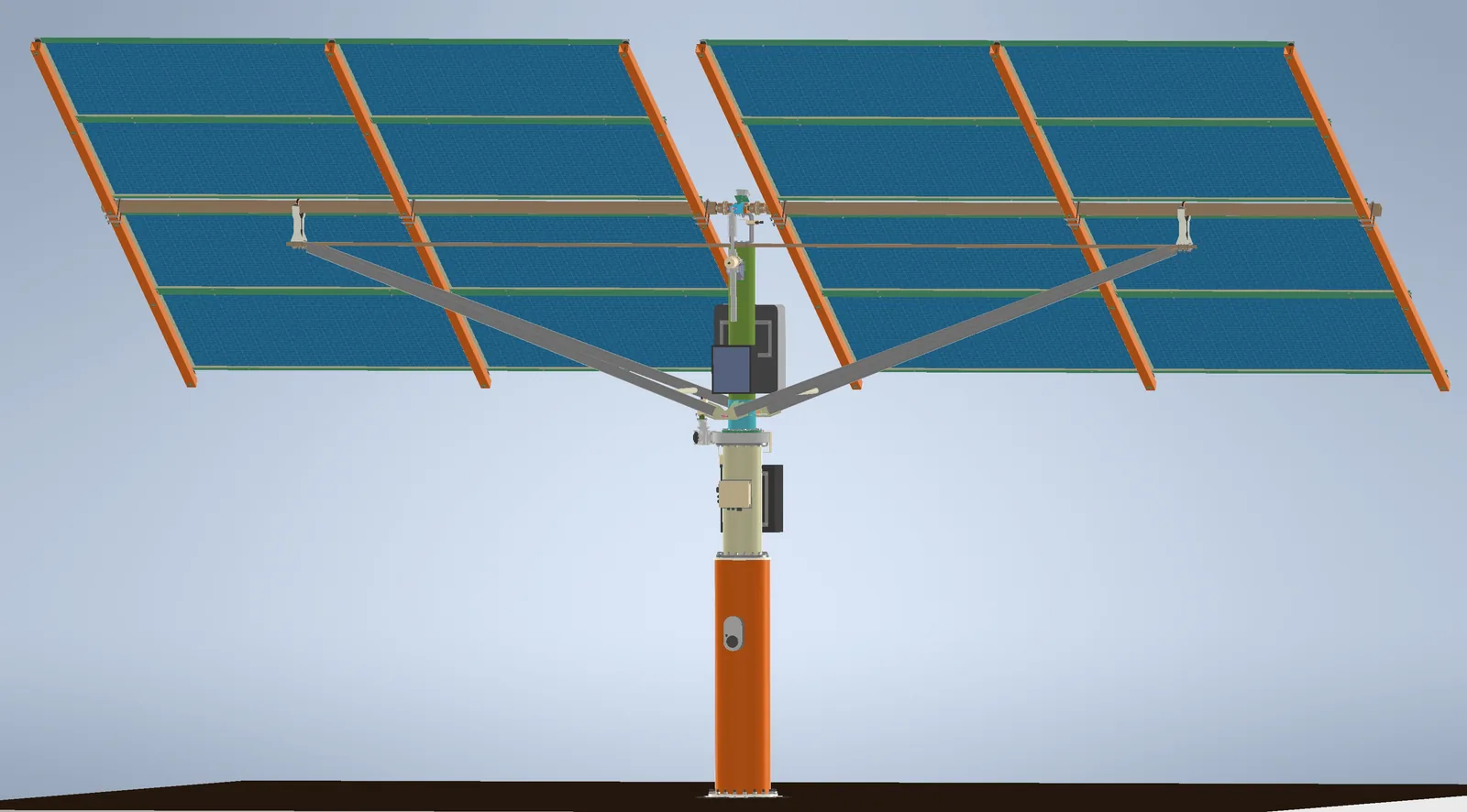
Sun Bridges 2AX 16P
Our 14.5 kWp tracker: sixteen bifacial modules on a single pole, a tubular space frame that keeps it rigid even in strong wind, an outdoor control cabinet and, on the pole, a socket to charge an electric car.
- Rated power
- 14.5 kWp
- Modules
- 16 bifacial modules of 3.2 m², 51.2 m² in total
- Axes
- two, azimuth and elevation, with continuous movement
- Wind
- stays operational up to 120 km/h
One pole, and the ground stays free
There are no rows of structures under the panels: the tracker goes where the space is also needed for something else.
Car parks and charging
Shade for the cars and energy to charge them, in the car parks of shopping and sports centres: one pole per tracker instead of a canopy, and on every pole a charging socket of up to 22 kW.
Farmland
For agrivoltaics: the panels stay at least 2.40 m above the ground and trackers are at least 14 m apart, so farm machinery of any size can pass and the field stays in use.
Businesses and industrial sites
Energy for the self-consumption of industries and public bodies, on yards and open areas, and solar fields that go up quickly, with production, batteries and charging followed live in Sun Bridges.
Completed
The first of the new generation, at Tecnopolo d’Abruzzo
At Tecnopolo d’Abruzzo in L’Aquila, where Bridges is based, the first Sun Bridges 2AX 16P with the new control system and the Sun Bridges platform is at work, following all the energy of the plant.
News
Bridges at Tecnopolo d’Abruzzo
We move to Tecnopolo d’Abruzzo in L’Aquila and start producing the Sun Bridges 2AX 16P: a plan of 1.5 million euros of investment and about 35 new hires over three years.
Sun Bridges on iPhone and Android
The app to follow Bridges trackers from your phone: current power, production and where the energy goes.
A new generation for the Sun Bridges 2AX 16P
A new control cabinet, the Sun Bridges platform and the Sun Bridges app: the tracker can be followed from a computer and a phone. The first one is at work at Tecnopolo d’Abruzzo.
Let’s talk about your plant
Tell us where you would like to install one or more trackers: a car park, a field, a business site. We will reply with a first assessment: how much energy it produces, how much it saves and how many years it takes to pay for itself.
Write to us